This book explores questions regarding the justice of war and addresses the lack of comparative perspectives on the ethics of war, particularly with respect to Islam. John Kelsay begins with the war in the Persian Gulf, focusing on the role of Islamic symbols in the rhetoric of Iraqi President Saddam Hussein. He provides an overview of the Islamic tradition in regards to war and peace, and then focuses on the notion of religion as a just cause for war.
This anthology by Christian ethicists and ecclesial groups is concerned with the justice of war in the twentieth century. Included are writings from Pope Pius XII, the Niebuhrs, the Calhoun Commission, John Ford, Elizabeth Anscombe, Paul Ramsey, Ralph Potter, the U.S. Catholic bishops, and the U.S. Methodist bishops. These authors, whose ideas reflect diverse trends in Roman Catholic and Protestant ethics, have sought to sharpen our moral literacy about the ethics of war and address ...
Based on the debates of bishops, church councils, and scholars who reflected on policy alternatives and invoked theological and ethical perspectives on the Gulf crisis, Lines in the Sand focuses on moral issues surrounding the Persian Gulf War. Alan Geyer and Barbara Green present a penetrating case study of foreign policy, military policy, moral argument, and religious discourse, while arguing that the "just war" tradition offers only partial aid for Christian reflection in matters...
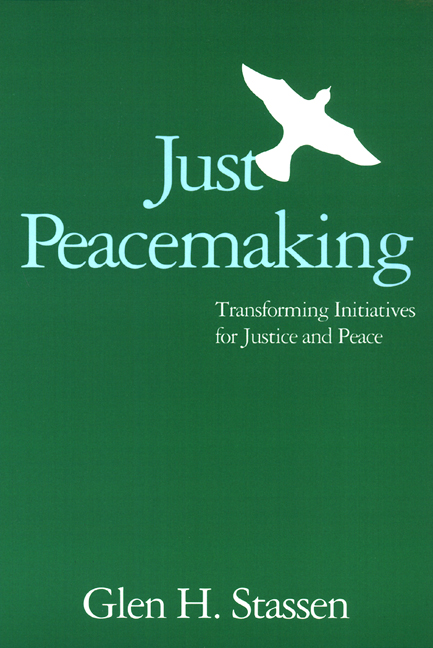
Glen Stassen believes Christians should direct their energies toward finding a set of criteria and a model for a "just peace" instead of "just war." He bases his just peace theory on the new reality of our world, on recent biblical interpretation, and on the experiences of people who lived in the face of oppression and nuclear threat, and who--together with political scientists, Christian ethicists, and activists--fashioned realistic steps toward peacemaking.
Ronald Thiemann believes we live in a time and a culture where there is little agreement concerning many basic moral questions. He claims the line between private and public, between personal and political, can no longer be drawn with absolute clarity, and if moral decision making has an inevitable political dimension, then moral and theological reflection must seek to help Christians in dealing with the public aspects of their lives.